


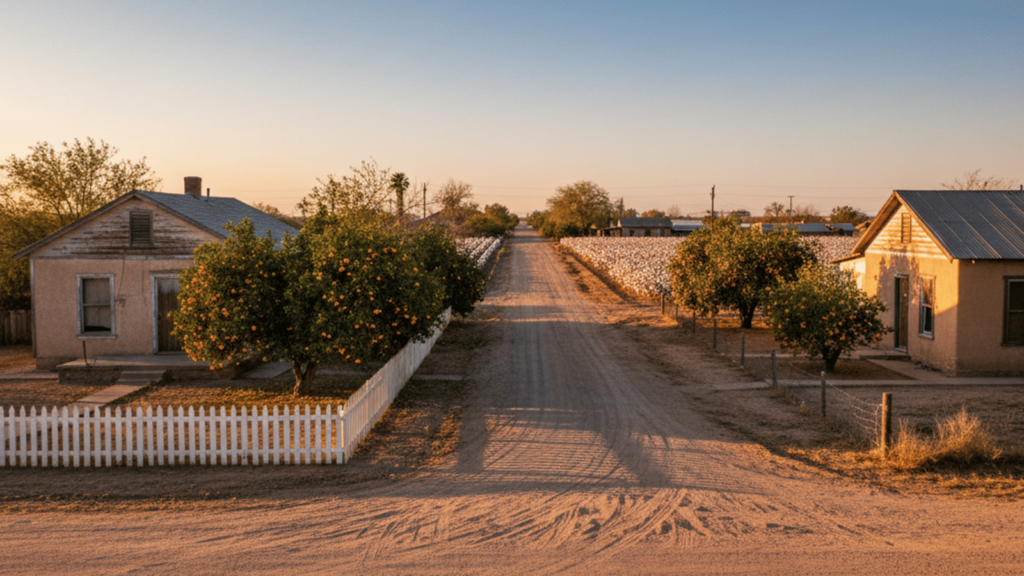
If you drive down Bell Road today, surrounded by bustling shopping centers, spring training crowds, and master-planned subdivisions, it is almost impossible to picture what this land looked like 80 years ago.
The most common question I get from newcomers isn’t about the schools or the taxes—it’s about the name. “Why is it called Surprise?” The answer comes down to the city’s founder, Flora Mae Statler. Legend has it she once said she would be “surprised if the town ever amounted to much.”
Flora Mae would probably be shocked if she saw the city in 2026. We have gone from a single square mile of farmland in 1938 to a sprawling metropolis approaching 170,000 residents. The history of Surprise isn’t a story of slow, steady growth. It is a story of explosive reinvention, transforming from a quiet agricultural stop into one of the fastest-growing cities in Arizona.
1938–1960: The Founding and Flora Mae Statler
Let’s rewind to 1938. The West Valley wasn’t a sea of tile roofs; it was a sea of cotton and citrus. Flora Mae Statler founded the town on just one square mile of land.
At the time, the town served a very specific, modest purpose. It was primarily housing for agricultural workers and a service stop for people traveling along Grand Avenue (US 60), which was the main artery connecting Phoenix to Wickenburg and Las Vegas.
If you want to see where it all began, you have to look at what locals call the “Original Townsite.” This historic square mile is bounded roughly by:
- Greenway Road to the south
- Bell Road to the north
- El Mirage Road to the east
- Dysart Road to the west
Back then, the atmosphere was rural and simple. There were no homeowners associations, no golf courses, and certainly no mega-malls. It was a tight-knit community working the land, completely distinct from the polished master plans you see today when looking at living in Surprise AZ.
1960–1990: Incorporation and Quiet Growth
In 1960, the town officially incorporated. This was a major step because it allowed the local government to manage its own services and zoning, separating its destiny from the county.
However, for the next three decades, Surprise remained a “blink and you’ll miss it” location. During this era, the city lived in the shadow of its famous neighbor, Sun City, which had opened with great fanfare in 1960. For a long time, outsiders often confused Surprise with the unincorporated retirement areas surrounding it.
Two major factors defined this era:
- Luke Air Force Base: Established nearby in the 1940s, the base became a massive economic engine. The sound of jets overhead became a part of daily life, and the airspace requirements helped shape where housing could and couldn’t be built.
- Slow Growth: Even by 1990, the population was hovering around 7,000 people. It was a small, quiet town that gave zero indication of the boom that was right around the corner.
The 1990s: Del Webb and the Retirement Revolution
The 1990s marked the turning point that changed everything. The Del Webb Corporation, having already built out Sun City and Sun City West, needed a location for their next massive project. They chose Surprise.
They began construction on Sun City Grand (recently rebranded as “The Grand”). This wasn’t just another neighborhood; it was a luxury resort-style destination. It brought wealth, beautiful infrastructure, and a significant tax base to a city that desperately needed it.
Suddenly, Surprise wasn’t just a farm town; it was a premier retirement destination. The arrival of Sun City Grand homes for sale put the city on the national radar. Driven largely by this single development, the population skyrocketed from roughly 7,000 in 1990 to over 30,000 by the year 2000.
2000s–2010s: The Suburban Explosion
Once the secret was out, the floodgates opened. While the 90s were about retirees, the 2000s were about everyone else.
City leadership aggressively annexed state land to the north and west, expanding the city’s borders significantly. Developers rushed in to build non-age-restricted master-planned communities like Marley Park, Sierra Montana, and Greer Ranch.
This caused a massive demographic shift. The median age dropped as households of all sizes moved in, looking for affordable new construction homes in Surprise. The population grew by roughly 280% between 2000 and 2010.
Of course, this growth came with growing pains. If you lived here then, you remember the traffic on Bell Road. The city and state had to play catch-up with infrastructure, eventually widening Bell Road and constructing the Loop 303 freeway, which became the critical lifeline connecting Surprise to the rest of the valley.
Building an Identity: Spring Training and the Civic Center
By the early 2000s, Surprise had the houses, but it lacked a “heart.” It didn’t have a traditional downtown Main Street like older cities. So, the city decided to build one.
They invested heavily in the Surprise Recreation Campus and opened Surprise Stadium in roughly 2002. Landing the Spring Training contracts for the Texas Rangers and Kansas City Royals was a massive coup, instantly making the city a hub for sports tourism.
Around the same time, they constructed the new City Hall and Civic Center complex. These weren’t just government buildings; they were designed to create a gathering place for festivals, concerts, and community events, giving residents a sense of place beyond their subdivision walls.
Modern Surprise (2020–2026): The Era of Prasada
Fast forward to where we are now in 2026. The last few years have been defined by the city finally becoming self-sustaining.
For years, we had a “retail leakage” problem—residents earned money here but drove to Peoria or Phoenix to spend it on dinner and shopping. The opening of the Village at Prasada changed that game completely. When it fully opened around 2022-2023, it filled the massive gap for dining, entertainment, and high-end retail.
Today, Surprise is no longer just a bedroom community. With the cost of living in Surprise AZ balancing out with new amenities, we are seeing a mix of luxury apartments, custom estates, and a booming industrial corridor along the Loop 303 that provides local tech and logistics jobs.
Historical Comparison: Surprise vs. Neighbors
To understand real estate here, it helps to know how we differ from our neighbors historically:
- Vs. Sun City: Sun City was an unincorporated master-planned community from day one (1960) and remains strictly 55+. Surprise is a diverse, incorporated city that contains retirement communities but is not defined by them.
- Vs. El Mirage: El Mirage shares our agricultural roots and Original Townsite feel but didn’t expand with the same aggressive master-planning in the 2000s that Surprise did.
- Vs. Peoria: Peoria is older and more established. Because Surprise developed later, our infrastructure—like the grid system and wide boulevards—feels more modern and planned for higher volume.
FAQs: Surprise History 101
How did Surprise, AZ get its name?
The name comes from the city’s founder, Flora Mae Statler. She famously stated she would be “surprised if the town ever amounted to much.” It has since become the city’s unofficial backstory and a testament to its unexpected success.
When was Surprise, Arizona founded?
Flora Mae Statler founded the town in 1938. However, it did not officially incorporate as a city until 1960, which allowed it to start managing its own services and growth.
What is the Original Townsite of Surprise?
The Original Townsite is the historic square mile where the city began, roughly bordered by Bell, Greenway, El Mirage, and Dysart roads. It remains distinct from the newer master-planned communities, featuring a more rural and historic character.
Why did Surprise, AZ grow so fast?
The growth was a perfect storm of affordable land availability, the success of Del Webb’s Sun City Grand in the 1990s, and aggressive annexation by the city in the 2000s. The construction of the Loop 303 freeway further accelerated this by making the area accessible to commuters.